
Arjuna
The transgender who led to death of the greatest warrior- Shikhandi

Family of Shikhandi
Shikhandi is a character in the Hindu epic, the Mahabharata. He was born as a girl child named ‘Shikhandini’ to Drupada, the king of Panchala. Shikhandi fought in the Kurukshetra war on the side of the Pandavas, along with his father Drupada and brother Dhristadyumna.
Past life of Shikhandi
In the majority of the versions of the Mahabharat,[1] there is the story of Shikhandi being Amba in his previous birth.
Shikhandini or Shikhandi had been born in a previous lifetime as a woman named Amba.
Vichitravirya married only her sisters, because Amba told Bhishma that she had fallen in love with Salwa, and was not ready to marry anyone else. Hearing this from her, Bhishma sent Amba with grandeur to Saubala. But Salwa rejected her as well, in shame of losing the combat against Bhishma. Amba then returned to Bhishma and demanded that he marry her according to Kshatriya dharma, but Bhishma declined due to his vow celibacy.
Her feeling of revenge
Enraged at her humiliation, she tried to persuade other kings to wage a war with Bhishma and compel him to wed her. None agreed for they were afraid of incurring the wrath of the great warrior. Amba managed to get Parashurama, Bhishma’s guru, to champion her cause. However, not even Parashurama could defeat Bhishma.
She resorted to penance and received a garland of blue lotuses from Lord Kartikeya and it was foretold that anyone wearing the garland would become the cause of Bhishma’s death. She went to the Panchal, as they were a mighty empire known for its military prowess. However, no one was willing to champion her cause, fearful of antagonizing Bhishma. Amba, in anger, hung the garland on the gates of King Drupada and left in agony.
Austerities performed by her
Amba did severe penance to Lord Shiva for a boon to cause Bhishma’s death. Eventually, her prayers were answered. But, being a woman with no military training, she asked Shiva how should would accomplish her task, and he responded that her future incarnation would be the one to actually bring about Bhishma’s demise. Eager to bring this about, Amba killed herself; in some versions of the story (to explain the time gap between the abduction at Kashi and the Kurukshetra war, Amba keeps on killing herself until she is incarnated into satisfactory situation.Amba was reborn as Shikhandini, the daughter of King Drupada
Her role in Mahabharata
In the battle of Kurukshetra, Bhishma recognised him as Amba reborn, and not wanting to fight a “woman” (or an actual woman, depending on the version), avoided battling Shikhandi. On the tenth day, Shikhandi rides in Arjuna’s chariot, and together, they face Bhishma, forcing him to lower his weapons. Knowing that this would happen, Arjuna hid behind Shikhandi and attacked Bhishma with a devastating volley of arrows. Thus, Shikhandi was instrumental in Bhishma’s death.
Shikhandi was finally killed by Ashwatthama on the 18th day of battle. Dazed and confused, Shikhandi is killed in a sword fight with Ashwatthama when Ashwatthama, Kripacharya, and Kritaverma attacked the Pandava camp on the night of the final day of battle.[8] In some versions of the Mahabharat, Ashwatthama kills Shikhandi’s lover (male or female) in front of him; in other versions, it is Shikhandini’s partner (male/female) who is butchered
Person apart from Arjuna who heard Bhagwad Gita directly from Krishna – Sanjaya
Usually we think that only Arjuna was the only person to whom Bhagwad Gita was told directly bu there is something else which we are unaware of.
Sanjaya is the only character of the Mahabharata who apart from Arjuna heard the narration of Bhagwad Gita directly from Lord Sri Krishna, The Supreme Personality of Godhead.
He was blessed by the divine sage, the incarnation of godhead, Sri Vyasa Deva to get the divine vision which helped him to see the battlefield sitting beside dhritarashtra and told him everything.
Despite of such a cruel warfare, he never lied to Dhritarashtra and kept on telling him about the death of the 100 sons
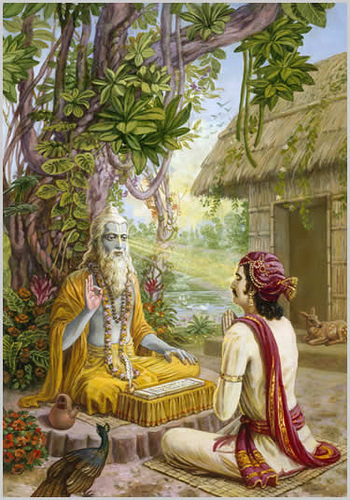
He was hearing Bhagwad Gita directly from Lord Krishna due to the blessings of his spiritual master as he was pleased by his menial service.
Many verses in Bhagwad Gita therefore, begin with Sanjaya Uvacha i.e. Sanjaya Said
His divine vision allowed him to see upto the distance of 80 miles from his area of residence, this is Divya Chakshu.
Babhruvahana

Babruvahana or Babhruvahana is a character in the Mahabharata. He is one of the son of Arjuna, begotten through Chitrangada, the princess of Manipur (present state of northeast india,Manipur or Kangleipak) during the period of his exile at Manipur.
Babruvahana was adopted as the son of his maternal grandfather and reigned at Manipur as his successor. He dwelt there in a palace of great splendour, surrounded with wealth and signs of power. Later he came to know Arjuna was his father, and when he came to see the his father, Arjuna did not recognise him and said he was a wanderer.
When Arjuna went to Manipur with the horse intended for the Aswamedha, there was a quarrel between Arjuna and King Babhruvahana(who is an avatar of Prabhasa) and the latter killed his father with an arrow. Repenting of his deed, he determined to kill himself, but he obtained from his stepmother, the Naga princess Uloopi, a gem which restored Arjuna to life. He returned with his father to Hastinapura. This was on account of a curse by the Vasus, on account of Arjuna’s killing Bhishma(who is an incarnation of Prabhasa) during the Mahābhārata war.
Arjun: The mighty warrior

The story of Mahabharata includes many characters and each of them has it’s own influential role in the epic. Since it is a composition of Ved Vyasa, hence it centres around the supreme lord and hence, it is meant for people who are devoted to him and wish to enjoy his pastimes in various forms.
Since Krishna is never alone, he is always surrounded by his devotees and hence, while mentioning of Krishna, his devotees are always mentioned.
In Mahabharata, there are many devotees of Lord Sri Hari and each of them has a separate role as well as eternal relationship with him. There are five major relations and seven minor relations.
The five major relations are:
- Shanta (Passive)
- Dasya (Servitorship)
- Sakhya (Friendship)
- Vatsalya (Parental affection)
- Madhurya (Conjugal love)
Arjuna is related to the lord in the relation of Sakhya i.e. he is a dear friend of the lord. The lord himself states in Bhagwad gita(4.3)
yogah proktah puratanah
bhakto ‘si me sakha ceti
rahasyam hy etad uttamam
Daily Gita and Srimad Bhagwatam

This is daily Gita and Bhagwatam Series in which we present their timeless and valuable teachings.
Today’s Verse
arjuna uvāca
dṛṣṭvemaṁ sva-janaṁ kṛṣṇa
yuyutsuṁ samupasthitam
sīdanti mama gātrāṇi
mukhaṁ ca pariśuṣyati
Translation:
Arjuna said: My dear Kṛṣṇa, seeing my friends and relatives present before me in such a fighting spirit, I feel the limbs of my body quivering and my mouth drying up.
Purport:
Any man who has genuine devotion to the Lord has all the good qualities which are found in godly persons or in the demigods, whereas the nondevotee, however advanced he may be in material qualifications by education and culture, lacks in godly qualities. As such, Arjuna, just after seeing his kinsmen, friends and relatives on the battlefield, was at once overwhelmed by compassion for them who had so decided to fight amongst themselves. As far as his soldiers were concerned, he was sympathetic from the beginning, but he felt compassion even for the soldiers of the opposite party, foreseeing their imminent death. And while he was so thinking, the limbs of his body began to quiver, and his mouth became dry. He was more or less astonished to see their fighting spirit. Practically the whole community, all blood relatives of Arjuna, had come to fight with him. This overwhelmed a kind devotee like Arjuna. Although it is not mentioned here, still one can easily imagine that not only were Arjuna’s bodily limbs quivering and his mouth drying up, but he was also crying out of compassion. Such symptoms in Arjuna were not due to weakness but to his softheartedness, a characteristic of a pure devotee of the Lord. It is said therefore:
yasyāsti bhaktir bhagavaty akiñcanā
sarvair guṇais tatra samāsate surāḥ
harāv abhaktasya kuto mahad-guṇā
mano-rathenāsati dhāvato bahiḥ
“One who has unflinching devotion for the Personality of Godhead has all the good qualities of the demigods. But one who is not a devotee of the Lord has only material qualifications that are of little value. This is because he is hovering on the mental plane and is certain to be attracted by the glaring material energy.” (Bhāg. 5.18.12)
Daily Gita and Srimad Bhagwatam

This is daily Gita and Srimad Bhagwatam Series in which we present their timeless and valuable teachings.
Today’s Verse
BG. 1.18
drupado draupadeyas ca
sarvasah prthivi-pate
saubhadras ca maha-bahuh
sankhan dadhmuh prthak prthak
TRANSLATION:
DRUPADA and the sons of DRAUPADI, and the mighty armed son of SUBHADRA also blew their several conches.
PURPORT:
Sañjaya informed King Dhṛtarāṣṭra very tactfully that his unwise policy of deceiving the sons of Pāṇḍu and endeavoring to enthrone his own sons on the seat of the kingdom was not very laudable. The signs already clearly indicated that the whole Kuru dynasty would be killed in that great battle. Beginning with the grandsire, Bhīṣma, down to the grandsons like Abhimanyu and others-including kings from many states of the world-all were present there, and all were doomed. The whole catastrophe was due to King Dhṛtarāṣṭra, because he encouraged the policy followed by his sons.
Daily Gita and Srimad Bhagwatam
![dhṛtarāṣṭra uvācadharma-kṣetre kuru-kṣetresamavetā yuyutsavaḥmāmakāḥ pāṇḍavāś caivakim akurvata sañjayaQ=&t=r={!M Wv==c=Q=m=-Z=eF=e ku-oZ=eF=e s=m=v=et== y=uy=uts=v=- +m==m=k-=- p==[#v==xc=Ev= ik-m=- aku-v=-t= s=]j=y=](https://shubhpuja.wordpress.com/wp-content/uploads/2016/05/dhe1b99btarc481e1b9a3e1b9adra-uvc481cadharma-ke1b9a3etre-kuru-ke1b9a3etresamavetc481-yuyutsavae1b8a5mc481makc481e1b8a5-pc481e1b987e1b88davc481c59b-caivakim-a.jpg?w=705) This is daily Gita and Srimad Bhagwatam Series in which we present their timeless and valuable teachings.
This is daily Gita and Srimad Bhagwatam Series in which we present their timeless and valuable teachings.
They are not mere cock and bull stories but essential truths related to self awakening.
Today’s Verse
Bg 1.1
samavetā yuyutsavaḥ
māmakāḥ pāṇḍavāś caiva
kim akurvata sañjaya
Bhagavad-gītā is the widely read theistic science summarized in the Gītā-māhātmya (Glorification of the Gītā). There it says that one should read Bhagavad-gītā very scrutinizingly with the help of a person who is a devotee of Śrī Kṛṣṇa and try to understand it without personally motivated interpretations. The example of clear understanding is there in the Bhagavad-gītā itself, in the way the teaching is understood by Arjuna, who heard the Gītā directly from the Lord. If someone is fortunate enough to understand the Bhagavad-gītā in that line of disciplic succession, without motivated interpretation, then he surpasses all studies of Vedic wisdom, and all scriptures of the world. One will find in the Bhagavad-gītā all that is contained in other scriptures, but the reader will also find things which are not to be found elsewhere. That is the specific standard of the Gītā. It is the perfect theistic science because it is directly spoken by the Supreme Personality of Godhead, Lord Śrī Kṛṣṇa.
The topics discussed by Dhṛtarāṣṭra and Sañjaya, as described in the Mahābhārata, form the basic principle for this great philosophy. It is understood that this philosophy evolved on the Battlefield of Kurukṣetra, which is a sacred place of pilgrimage from the immemorial time of the Vedic age. It was spoken by the Lord when He was present personally on this planet for the guidance of mankind.
The word dharma-kṣetra (a place where religious rituals are performed) is significant because, on the Battlefield of Kurukṣetra, the Supreme Personality of Godhead was present on the side of Arjuna. Dhṛtarāṣṭra, the father of the Kurus, was highly doubtful about the possibility of his sons’ ultimate victory. In his doubt, he inquired from his secretary Sañjaya, “What did they do?” He was confident that both his sons and the sons of his younger brother Pāṇḍu were assembled in that Field of Kurukṣetra for a determined engagement of the war. Still, his inquiry is significant. He did not want a compromise between the cousins and brothers, and he wanted to be sure of the fate of his sons on the battlefield. Because the battle was arranged to be fought at Kurukṣetra, which is mentioned elsewhere in the Vedas as a place of worship – even for the denizens of heaven – Dhṛtarāṣṭra became very fearful about the influence of the holy place on the outcome of the battle. He knew very well that this would influence Arjuna and the sons of Pāṇḍu favorably, because by nature they were all virtuous. Sañjaya was a student of Vyāsa, and therefore, by the mercy of Vyāsa, Sañjaya was able to envision the Battlefield of Kurukṣetra even while he was in the room of Dhṛtarāṣṭra. And so, Dhṛtarāṣṭra asked him about the situation on the battlefield.
Both the Pāṇḍavas and the sons of Dhṛtarāṣṭra belong to the same family, but Dhṛtarāṣṭra’s mind is disclosed herein. He deliberately claimed only his sons as Kurus, and he separated the sons of Pāṇḍu from the family heritage. One can thus understand the specific position of Dhṛtarāṣṭra in his relationship with his nephews, the sons of Pāṇḍu. As in the paddy field the unnecessary plants are taken out, so it is expected from the very beginning of these topics that in the religious field of Kurukṣetra, where the father of religion, Śrī Kṛṣṇa, was present, the unwanted plants like Dhṛtarāṣṭra’s son Duryodhana and others would be wiped out and the thoroughly religious persons, headed by Yudhiṣṭhira, would be established by the Lord. This is the significance of the words dharma-kṣetre and kuru-kṣetre, apart from their historical and Vedic importance.
The Karmic battlefield of Life: Teachings of Bhagvad Gita
 “Na ca saknomy avasthatum bhramativa ca me manah nitmittani ca pasyami viparitani kesava”; meaning- O Krishna, I am unable to keep composed; my mind is unsteady, and I see dire indications of inauspicious omens.” The supreme Krishna guided the perplexed Arjuna on the battlefield of Kurukshetra and the direct gospel from the lips of Lord Krishna holds significance in our daily lives and provides solutions to everyday troubles.
The 700 shlokas across 18 chapters as a part of epic Mahabharata highlights the Vedantic views, which needs to be imbibed in our lives. The core philosophies of karma, dharma, reincarnation, atman, brahman, maya and moksha forms the basis of the teachings of Krishna.
Know Thyself:
In the beginning of the chapter, the act of knowing your true self i.e. leaving apart the physical body and materialistic possessions that are delusion, identify your higher self or eternal soul. When man is free from the effect of happiness, sadness, fear, anger, anxiety and other such emotions; then he completely connects with the supreme power and stays neutral and contented at every situation in life.
Be in the moment:
Gita explains about the relevance of cherishing the journey more than the final destination. Whatever field you have mastered in, the pleasure of creating yourself up to that level is more inspiring and beautiful than the final end of creation. So be it any phase of life, if you live in that very moment without being judgemental about results, the greed and curiosity for more, vanishes.
Oneness:
Gita highlights the necessity of weighing everyone at the same level, be it friends or foe. “He alone sees truly who sees God in every creature he does not harm himself or others.” If the Supreme father doesn’t discriminate among all his kids, then how can we mortal beings perform against the law of nature? As the feelings of acceptance indulges the flower of love blooms within us and provides the strength to treat everyone as One human family.
Be cautious about your actions:
Lord Krishna explains Arjuna that every situation in our life is the result of our prior actions; fate and destiny need not to be blamed. Think about what you are doing right now, as your present actions decides your future results. The beautiful life is a gift of God, utilise it now and get rid of your flaws within time.
Have faith on HIM:
Almighty is infinitely more, beyond what can be seen, felt, heard by our physical senses; so it’s pointless to be thoughtful about every action on this planet. Have faith on his supreme blessings and say ‘I am in you and you are in me’. This bestows you with strength that prevents you to get trapped in the vicious circle of life.
Perform your duty:
“You might like another’s duty, and dislike yours. But still, do your own duty, and not another’s, even if you can do another’s duty very well. Or you’ll go on being caught up in the field of opposites. And there will be no end to your suffering.” It is much easier to become a hermit and stay in forest, leaving your family and responsibilities; but the true challenge is to perform your duties within the world of illusion and stay connected to the true self every second.
Act good, the lord is watching:
As a watch keeper, the Lord is aware about every act you perform. We can fool other mortals but not the supreme power. So be true to yourself and act wisely, without expecting the fruitful results, as it is your journey that matters. Gita says that you keep doing your duty in the best way you can and there will always be bigger power that will protect the truth. In short, never stop your war against injustice just because your enemy look so formidable. ‘In order to deliver the pious and to annihilate the miscreants, as well as to re-establish the principles of truth, I advent Myself time to time.’
The elements of Bhagvad Gita has been inspiring from the life of Mahatma Gandhi to Robert Oppenheimer, so why not you. Each one of us is Arjuna on the karmic battlefield of life, and the teachings of Lord guide us to win the battle against our own blood relations.
Contributed By: Meenakshi Ahuja
Arjuna was in win-win situation: 10 facts that made Arjuna a perfect character!
 A story becomes a great epic only because of its characters and their peculiar traits, which leaves the footprints on the sand of time and stays eternal forever. The portrayal of niche thinking, complexities and determination of attaining fame; better explained through the phrase ‘Everything is fair in love and war’ and yea it was definitely ‘The War’. The great epic, Mahabharata marks the beginning of egocentric, shrewd and all other negative sides of human nature with a tint of humanity.
Though every character justified with their specific roles, yet the hero is only one and probably ‘Arjuna’, the middle one out of the five Pandavas warriors out shined as a true hero. I am not saying that ‘Arjuna’ was a perfect character but in spite of his own complexities or as per the plot of the story, he was usually in a win-win situation.
#A grand celebration was performed at Arjuna’s birth and Lord Indra was gratified by the success stories of his son and called himself a proud father of Arjuna.
#Arjuna was focussed and perspicuous about his goals and he earned his success by working hard. He practised to shoot an arrow in darkness as well as by hearing the minute audible sounds.
#Arjuna remained in the priority wish list of Bheeshma and Dronacharya forever. Both the talented warriors supported him and even opted for inappropriate actions to prove his excellence.
#Karan being an equally capable warrior as Arjuna, could never flourish because of his karmas and favouring the wrong doers i.e. Duryodhan; which indirectly lead Arjuna to excel.
#Arjuna’s feelings for his beloved Draupadi were true but sharing his wife with the other four was not his idea. Yet he abided his mother and accepted the truth.
#In spite of any complex situation, Arjuna bestowed full faith upon his soul mate- Lord Krishna and received his hearty blessings as a devotee and follower.
#At one point, Arjuna had to raise his sword to kill his dear brother Yudhistra, as per his oath. Yet Arjuna could not accept his own deed of disrespecting his brother and paid for his sin.
#The moral code and empathetic attitude of Arjuna, made him receive laurels and blessings from all his relations.
#Till the end, Arjuna had a soft corner towards Karan and respected him as a brave competitor. Only to abide by his master’s wish, Arjuna had to shoot an arrow on Karan.
#In spite of an opportunity of choosing the great army of 10,000 warriors, Arjuna remained firm with his decision of choosing Lord Krishna. The success of Arjuna was sure shot, since he preferred to sit near his master’s feet rather that near his head like Duryodhan.
The enlightening journey of Arjuna in holy Bhagvad Gita is an epitome of his successful and perfect character and proves my above statement judiciously.
Contributed By: Meenakshi Ahuja
 Shubhpuja.com